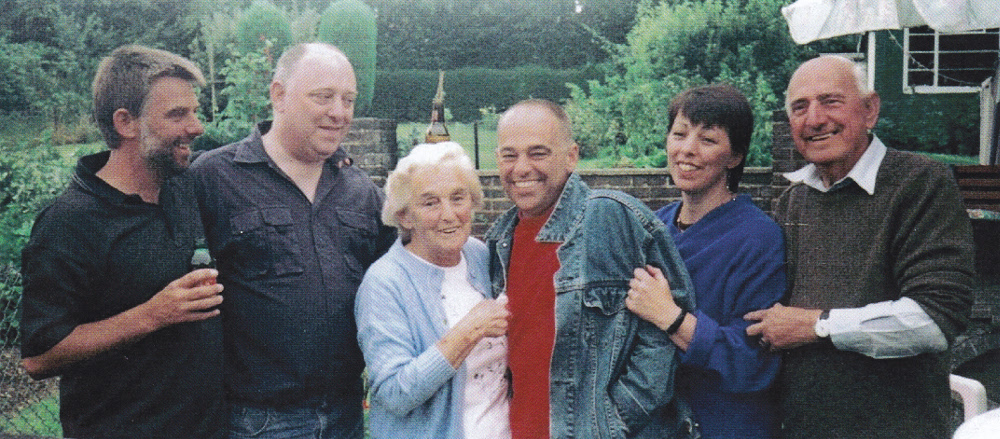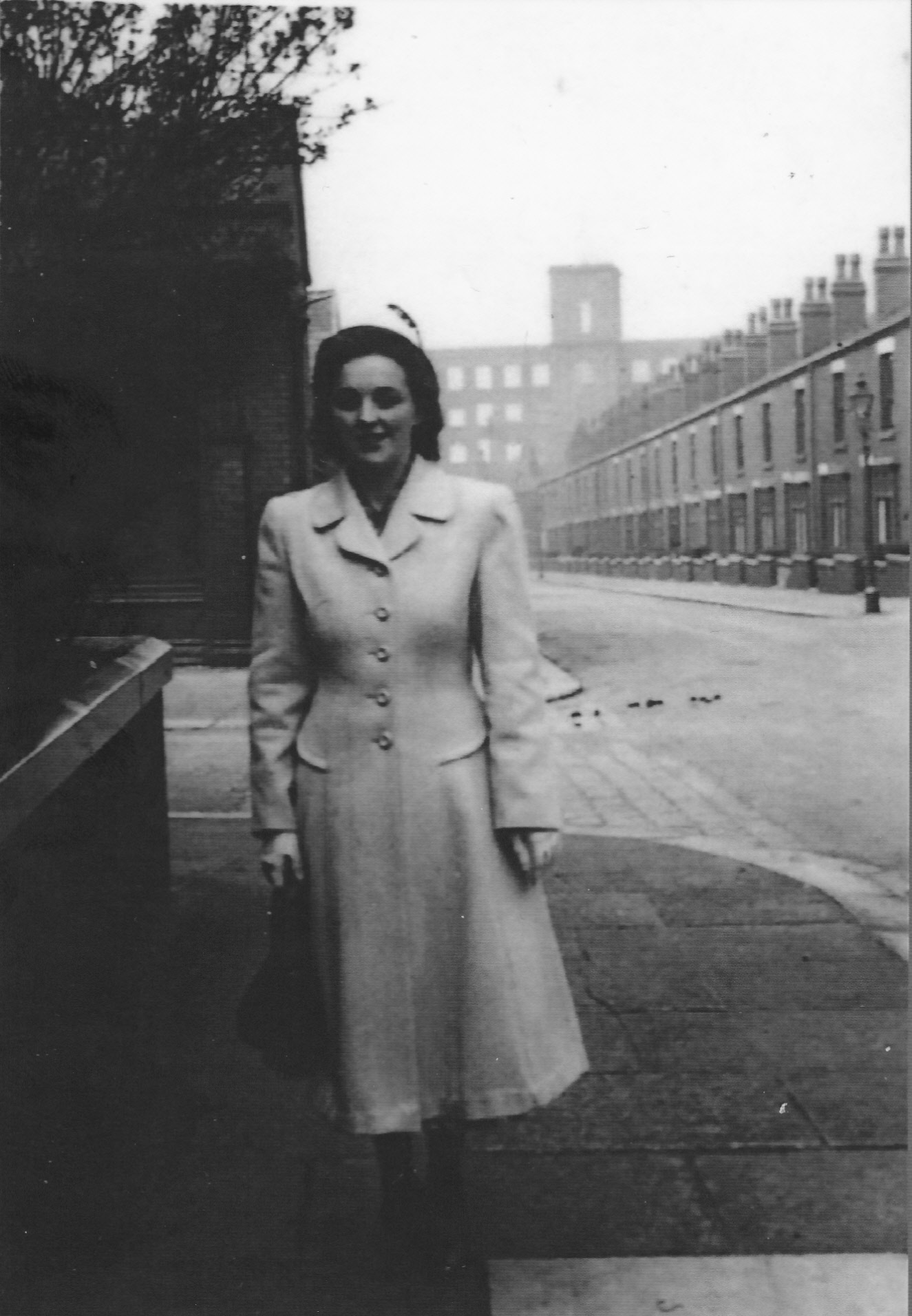
Kathleen Smith
My Life
My name was Kathleen Thorpe.
No, just Kathleen.
I was born June, 1924. That was in Bolton, in Lancashire. I’ve just remembered, through the help of my sister where I was born and that was Nelson Street. That was in Bolton. As far as I remember we lived with an aunt of my father’s for a while. Now I must have lived there until I was probably about three years old, when we moved to Calvert Road, where we lived for many, many years. I lived there until I got married. I got married from that house, and we lived there for about a year after.
Well my mother had always lived in Bolton. Families those days didn’t move around too often. My father came from Yorkshire originally. Now I don’t know what age he was when left Yorkshire and came to Bolton. His parents, his mother died when he was a baby. I don’t know when his father died. We never knew his father. My mother was from Bolton. The family seemed to be split up somehow, after his mother died. And I think he was with Auntie Lily- that was one of his sisters. I don’t know quite who he lived with, but he came to Bolton. Then he eventually got married to my mother.
My mother was called Lily Scofield and my father was Wilfred Thorpe.
When I look back now, he had a very happy childhood and we were very well looked after. My father, who I loved dearly, I wouldn’t say he was strict, but you always knew just how far you could go. Just that look on his face. My mother was much the same. She’d just give you a rap on the hand, she never hit us at all. We were very fortunate.
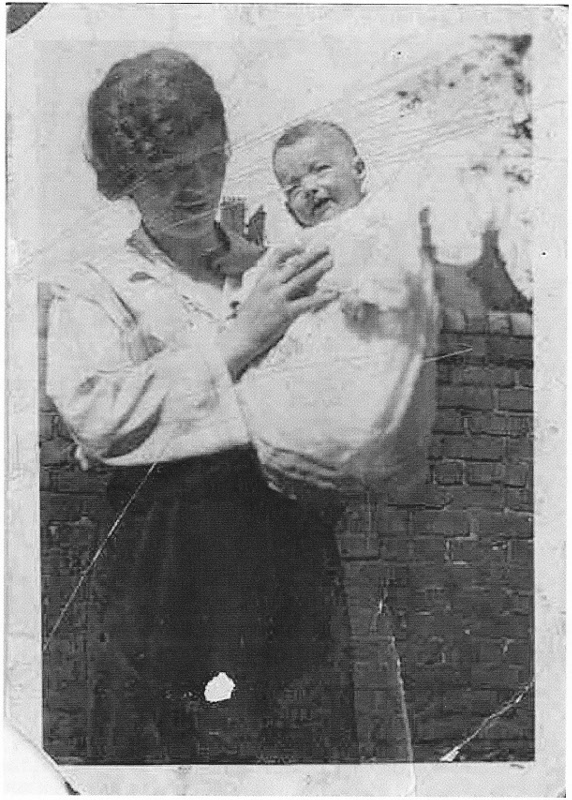
He worked in a departmental store called Horricks where he was head of the carpet department.
The only grandparent I remember was my grandmother, my mother’s mother. Her name was Anne Scofield. She lived with us for the last two years of her life. She was in her eighties, and she was a lovely gentle sort of lady. She never spoke ill of anyone. She taught us how to play cards. You never heard her talk about anybody or anything like that. She was in her 80’s, her husband- I don’t know when he died, but we never knew him. And my father’s parent’s, his mother died when he was a baby and I don’t know when his father died.
My mother was the youngest of 10 so there were a quite a lot of aunts and uncles and cousins. They mostly lived in the Bolton area. My mother had a brother who was killed in the war. I’m not too sure, but I think there were 2 who died. I remember my uncles and their wives and their children. When Grandma lived with us, they all used to come to our house in time for the Queen’s speech on Christmas. That was 3 o’clock in the afternoon. Then we had our tea- they all contributed and brought something. My mother used to make little trifles, and everyone would bring a bit of drink or cake or something. My cousins were mostly older than us.
Uncle Jim was one of my mother’s brothers- he was brilliant. He had so much patience with us. I remember one Christmas, we were all sat in the front room. And there was a knock at the door, and he was dressed up as Father Christmas, and he had his sack with presents. One time after he’d left Sheila piped up and said “Do you know Father Christmas had some slippers on just like Uncle Jim wears”. They still never cottoned on. He was so kind. One time when it was my birthday, we used to listen to the radio. They used to wish you happy birthday on the radio if you sent it in. Well I was very innocent then. And Uncle Jim came from work, he worked in the mill. He went upstairs and unbeknownst to me, they kind of switched the radio off, and he had a microphone upstairs. And over the microphone he said “I believe it is someone’s birthday today- Kathleen Thorpe.” And he wished me a happy birthday and I thought it was all coming from the radio. (laughs)
He married quite late in life and he never did have any children. They lived with Grandma, she had a house further up before she came to live with us. Uncle Jim’s wife was a bit of a workaholic. Grandma wasn’t very happy so she came to live with us.
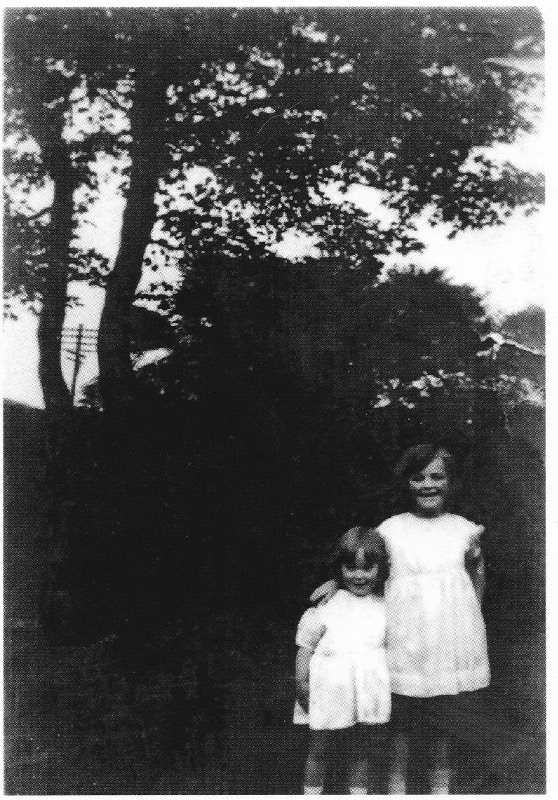
Yes, I was the oldest, and Sheila was my sister. She was four years younger than me. Her middle name was Mary.
I remember the day Sheila was born. I remember it distinctly. I wasn’t aware that my mother was pregnant or anything like that. You never talked about things like that then. Mind you, I was only four years old. So these friends of my mother, they had a car, which in those days we thought was absolutely wonderful. We thought they must have been very rich, that they could have a car. And they came and said they were taking me out for the day, and that I might be surprised when I got home. And I remember coming home and I went upstairs and my mother was in bed, and there was this little baby lying in the bed next to her. I just gazed at her, you see.
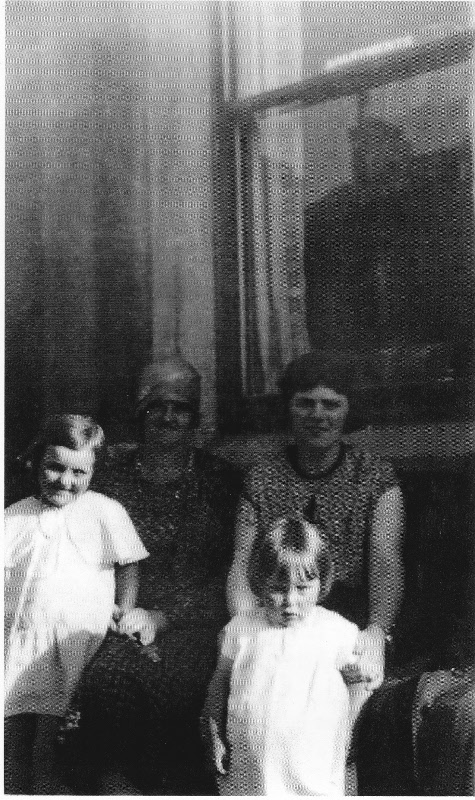
That was 1928.
I remember the house we lived in, in Calvert Road. They were terraced houses. We had what they called a sitting room then. And then we had a dining room. And we had a kitchen and we were fortunate, we had a bathroom upstairs. And we had two smallish bedrooms and a bigger bedroom- three bedrooms in all.
I can remember when they had the old fireplace taken out. It was an iron thing which you used to black polish every week. We used to do a lot of cooking in that oven. It was in the dining room area.
There were plenty of children in the street, they used to all play around. Bonfire night was quite good. We used to collect wood. People used to bring potatoes and they used to roast them in the fire. People used to make parkin, it was like a treacle cake they used to make for bonfire night. Of course, you didn’t have all the fireworks like they have today. All the people used to bring the chairs and they used to sit around the fire. It was all good fun, really.
We used to play a game called hop flag, and you had these square wooden things, and you had to draw a pattern on the ground and you had to hop into the next square. We had skipping ropes and we had top and whip. And we used to have a stick with a piece of leather on it, like a spinning top. We had a radio and I used to like to listen to it on a Saturday. It was different music then.
Well we had a lot of meat and potato pie, which was lovely. We always had often on a weekend, a Sunday joint. If there was any meat left, it could be minced up and made into rissoles, or it could be fried and you could make a potato ash. It was done with carrots, onions, gravy and that. My mother’s specialty was suet puddings and meat puddings. And these dumpling type things. They were really good. In fact, my grandma used to bake all her own bread. They had baking day, when they used to bake. We always had fish on Friday. You didn’t eat meat on Friday.
I did like potato pie, I must admit. We didn’t eat as many treats back then, sweets were ore of a treat then, particularly during the war when we had a sweet ration. We used to get a Saturday penny and I used to spend ages gazing at the window deciding what to spend my penny on. Some people managed to save half of it, I don’t know how they did it (laughs). You would go to the chip shop and get a pennyworth of chips. And we used to say “can we have some scraps?” They used to keep that at one side and you could have a few scraps then.
Yes, they had a children’s Mass when we were growing up. We used to go to Sunday school in the afternoon as well. I vaguely remember making my first communion. I wore a white dress with a veil. At the Church where you made Communion, we used to go for breakfast. We sat at this long table. And these nuns came around and I remember this nun touched my head and she said “you’ll be a nun one day” and I thought that was wonderful. (laughs)
We had a budgie, Pretty Boy. And every night, we used to let him out of the cage and he used to fly around. Every night, round about 6ish, my dad was due home from work, this bird used to fly on top of the door and he used to wait for him to come in. One day it got free and I don’t quite know how it happened, whether it was a window left open. And we went out and tried to find the thing. We went to the next road and in the next road there was a big row of houses and there was a big railway line right next to the houses and there were the trees and this bird was sat perched in the trees. We tried all sorts of things to make it come down, we brought its cage there. And in the end my dad said come on let’s go home. So we all turned and went, and as we turned, it flew down, sat down on my dad’s shoulder and never moved until we got in the house. It was quite remarkable, really. And then sadly it got out of its cage.
One day my mother wasn’t very well- she was very house proud. She went out one day and her parting words were “Don’t let the bird out” and as soon as she went round the corner we let the bird out. I think Sheila was in the kitchen and was doing the washing up and she had some very hot water. It was all fluffy and sudsy and this bird flew down and scalded its’ feet. And the poor thing died after that. We didn’t have any more pets after that. My mother didn’t like cats, she was frightened of them. That rubbed off on me because I’ve never been fond of cats.
That was a real event. It was always on a Monday, come hail rain or snow. You had to boil all your water up and you had a big metal thing that you put the clothes in and you had what was called a posser. A long stick with a round wooden base at the bottom and you used to rub all your clothes with it. You then put them through the mandle and then hung them out to dry in the back street. And sometimes you’d hear someone calling “quick, the coal man’s coming” and you had to bring in all your clothes so they wouldn’t get dirty. If it was a wet day, that was very unfortunate because you had a big roaring fire and you had a line inside with your clothes all strung up around and you had what they called a maiden, we had two big maidens around with clothes on them. And there was so much steam. On Tuesdays, you did your ironing. They had days for doing things. Wednesday was probably doing bedrooms and cleaning windows. It was all manually done in those days.
Yes, he was a Scottish man we had when we were little. Called Doctor Smith. He used to come to the house. Oh he was great, he was lovely. I remember when I had children, once, Pete wasn’t well and he’d been up most of the night and in the morning we sent for the Doctor and by the time he came along, after his surgery, Pete was running around playing. So the Doctor gets on his cowboy hat and runs around with him playing with him. I told him I was sorry for ringing but he said never hesitate with a child because they can be up and down.
When I was about fourteen I had appendicitis. I’d been in hospital just prior to that for an abscess on my leg. They sent me home to recuperate for a month and then I had to go back and have my appendix out. Unfortunately, I had a bad attack one night and they had to rush me to the hospital. Luckily it was only appendicitis, and the Doctor said if it had been left until morning, it would have burst. His daughter had that.
Well we had poultices when you had a bad finger and things like that. You used to have to drain it all and put it on the sore. And then Friday night you used to have a spoonful of syrup of figs, to make sure you went to the toilet (laughs) it tasted horrible really. I had to have some castor oil from time to time. They used to mix it with orange juice and I used to throw it all back up.
Oh, well I mean, they were not as relaxed as they are now. You had the matron came around and every bed cover had to be the right angle you know, and you’d sit there and nobody complained. They all did as they were told, more or less. You didn’t question anything in those days you see. You went to the Doctor and you did as they would tell you.
To be perfectly honest, not a great deal. My best subject was English. I suppose my worst was what they referred to as sums. I was good at composition. I remember one or two of my teachers were nuns. We used to have Miss Derbyshire, she was called. She used to shout quite a lot and when she spoke she used to spit a bit (laughs) I remember one time, she’d asked someone a question to someone at the back and no one could answer the question. For some reason when it came to me I got a swipe across the face. Every Friday afternoon she used to bring a big tin of sweets and give us all a sweet.
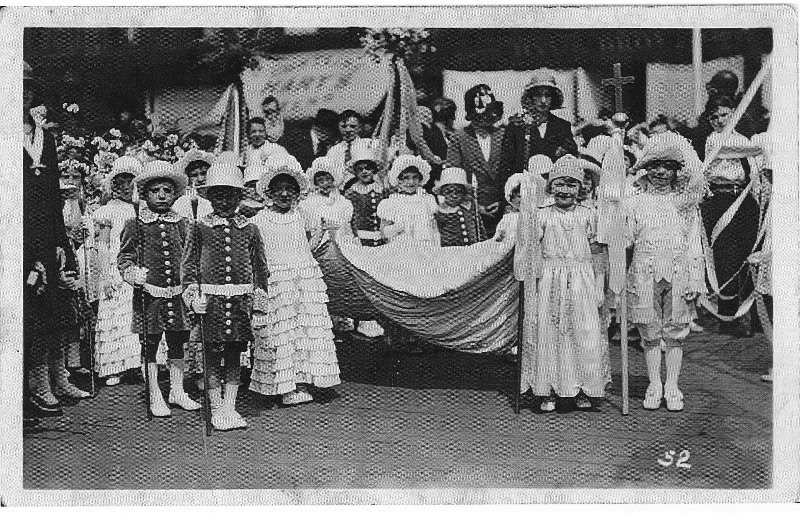
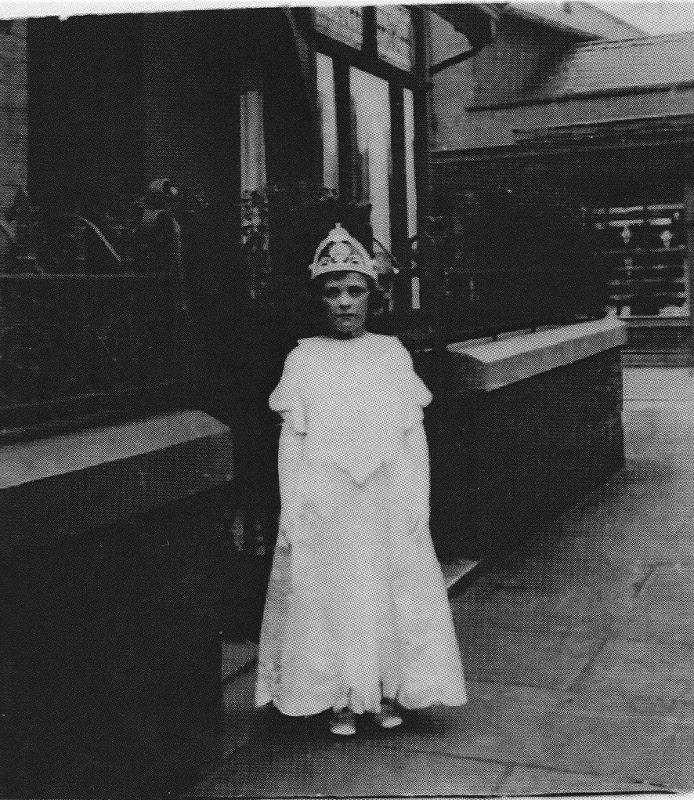
When I was there I was chosen as May Queen one time. I had to go to Manchester to have a crown fitted and I had this long train. All my family, my mother’s brothers helped with the cost of it, they all paid for something. And I had a staff with flowers on it. It was quite an event. I don’t remember a lot of the details. I remember going up the steps on this ladder to crown the statue of Mary and the priest had hold of my ankles. But he held on to make sure I didn’t fall off. That was in the junior school. I went to St. Peter & Paul’s school. I was about 11 then. I was made head girl at that school. It was a great honour. They used to vote for you, I think there was a little competition going on. And this teacher told them to vote for me. The head mistress was a nun. Every morning I had to go in a bit earlier and dust off her desk. And you’d be on duty in the cloakroom and things like that. It was just girls in that part of the school.
There was also a Miss Clarkson and Miss MacAvoy and Miss Smith in the junior school and her sister taught in the senior school and another sister taught in the boy`s school. There were 3 Miss Smith`s there. We sometimes had a bit of homework, not much.
I remember as a teenager, I used to peroxide my hair, it looked a bit hideous I think. My hair was very straight. When I got older I got perms. We used to buy clothes in the shops but not very often. There were quite a lot of dressmakers. My auntie, my mother’s sister used to make dresses for us. My mother used to do sewing knitting as well. She did a lot of knitting for my children. It really had to be something special to go into the shops. When Sheila and I were younger we had these coats made and these little hats to match. We were not that fashion conscious but we liked to look nice. We got dressed up for the dances.
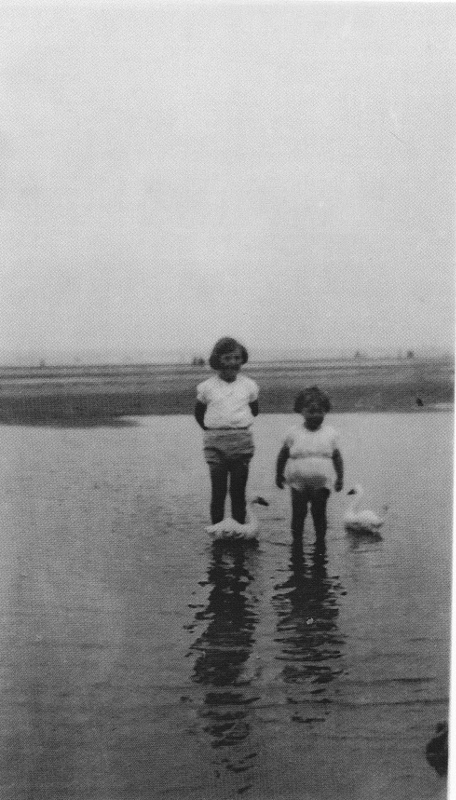
Yes, we did. We used to go to Fleetwood. We used to go, my mum, dad, Sheila and I, and my mum’s sister Bertha. We used to call her Auntie Bid. And they had two boys John and Jeff. We used to go and stay in this boarding house and we used to buy the food and the lady would cook it for us. Every morning John and I used to go to the shops and we used to get this bread and it was called a Blackpool roll. I thought it was the most beautiful bread in the world. We used to go down to on beach and we’d play cricket there. I can see my dad now running between the wickets. We used to go on the Pier. I had a sixpence once, which was quite a lot of money. And I dropped it and it went through the wooden slats and disappeared into the sea. I was really upset about this. I got home and they had a little collection for me and I think I got about seven pence. We used to have a lovely time at Fleetwood.
One time we went out fishing and this man came out with us, we used to hire a fishing boat. I threw my line out and it went with the rod into the sea. And my dad wasn’t very happy about that (laughs) He had to pay for the fishing line. We caught some little tiny fish, like a sprat. The lady at the house cooked it for us. (laughs) They always had wakes week. The mills were closed then. Everybody either went to Blackpool of Fleetwood, so you met everybody you knew as you were walking along. They were really nice holidays.
Well my mother’s brothers, some of them worked in the mills. I don’t really remember my dad’s family. But his sister once, she came to live with us. She lived in London, she got bombed out during the war and came to live with us. Eventually she lived with us.
Yes well radio was probably around then, most of us had it. And the first person I knew to have a television was my friend in Bolton who I went to school with. It was just her and her husband then, they didn’t have any children. She was called Kathleen Barton then and she’s now Mrs. Broderick. I remember going round to their house, people from America were over, and we all went round because they had a television. And you sat there, and the light was switched off, you didn’t have any lights on. And we all thought this was absolutely wonderful, having a television. And everybody sat glued to it. They had children’s programs on. I always used to watch Bill and Ben, Flowerpot Men. Coronation Street was on years after that. I know on the radio, on a Saturday night they used to have some really good plays. We used to really enjoy them. As I was getting older, on a Sunday morning, they used to have the Forces Favourites. You could request a song. It was called modern music. I used to like Gracie Fields and Vera Lynn- she was what they called the forces sweetheart. They had a lot of dance bands then. My dad always like classic music, and I used to hope he didn’t turn the radio off. Later we had a television then but it had broken down and we used to listen to the radio then. And we brought this new radio and it was put on the rug for some reason. And the kids all sat round it like they were watching television. But it was the radio you know.
You had your ration book you see. One week you got a certain amount of butter, and some margarine, next week you’d get more butter and less margarine. You also had a sweet ration. You could get hold of coupons for clothes and bedding, things like that. You could only have a certain amount of things. You could buy things on the black market if you had money. Things were rationed but you always managed somehow. You had meat rations as well. People grew their own vegetables and in those days they used to have allotments. No great shortages, except I don’t think we saw a lot of bananas and things like that. Nothing was wasted. People didn’t buy ready meals and we didn’t go in restaurants or things like that. When they started the supermarkets, they put the small shops out of business. If my parents could come back now and see the size of the supermarkets, they probably couldn’t take it in. (laughs)
Oh yes we had an air raid shelter in the back yard. Everybody had one, an air raid shelter. You used to go in there and sit there. I can’t remember what we did in there really. They used to have Air Raid Wardens going around checking you. I think it was a voluntary thing. We all had blackout curtains so there was no light showing so the planes going overhead couldn’t see the lights in your house. Where we lived, we were very lucky, we didn’t have bombing like they did in London and Liverpool and places like that. They did really suffer there in London, Manchester and Liverpool. We got the occasional bomb. You had to come out of the cinema if there was a bomb. They stopped the dances if there was a bombing. You were always a little bit hesitant with Germans, even after the war, which was silly really, because when you look at it logically, all wars are terrible. They are all somebody’s sons who are being killed in the war, you know, whether you were German, English, whatever you are.
Yes I knew quite a number of people who served in the war. My dad was in the Army, in the First World War. He didn’t talk about it a lot. He was away for quite some time. It was before I was born. My mother’s brother, Uncle Tom, he was killed in the First World War, but we never knew him. And my friend who came from America, she served in the American forces. And we knew several people of our age group, they were called up at a certain age, eighteen I think it was. I mean, it was all very stressful for the families you know, who had people in the war. If you were called up you had to go. You got your call up papers at a certain age, I think it was eighteen.
The lad who lived across the way from us. He was Marshall when I was the May Queen. He was in the Merchant Navy, I think it was. He was torpedoed several times, but he survived. I know two or three more who were killed in the war. And my friend Kathleen, in Bolton, her sister- they boy she was with- he was killed in the war. And, there was quite a number of them. And I always remember, when the war was declared, I can still see my Grandma now, and she really cried. Because she lost a son you see, in the First World War. Ann Scofield was her name.
When the war started, they announced on the radio “War has been declared…” I think I was probably about 13 or fourteen. Because I’m pretty sure that when I got my identity card, I was in hospital, because I had appendicitis. I remember everybody had to have an identity card. That was during the war. I’ve still got Ronnie’s somewhere.
Well, anybody could stop you. My friends, my cousins, they came over. They lived in America, their father died. The mother was English and they came back over here. But during the way, they had to report somewhere every so often because they weren’t English, they were American.
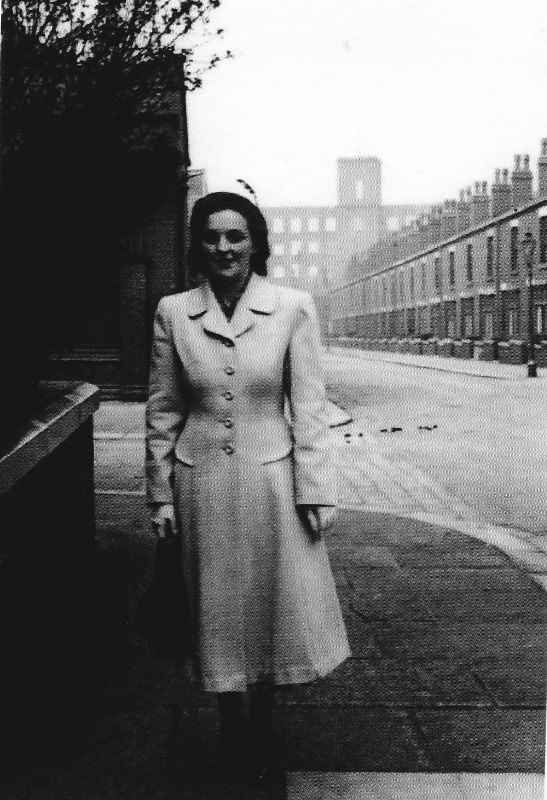
Well, we used to go to dances at the school. They had dances at the Church Hall on a Saturday night. And everybody really enjoyed it. They played records. They didn’t have a band, I’m pretty sure. If they wanted to go for a drink, attached to the Church on the grounds there, there was a big bowling green and there was a clubhouse there. If people wanted to go for a drink, they used to go there. I do remember when we used to go to the New Year’s Eve dance at the Church. That was always a big event. I always remember one time, I think I stayed out too late because I was told I had to be in at a certain time. I don’t remember where I was, probably with Ronnie. Anyway I was told by my Dad, well, there’s no New Year’s Eve dance for you this year. But I wasn’t unduly upset because I knew nearer the time, my dad would say I could go, which he did (laughs).
Quite a lot earlier before then, in my early teens, a group of us would meet up and we’d go hiking on the moor. We used to take our sandwiches. A real group of us used to go- my cousins John and Jeff, Thelma, Ilene and several people. We used to wear a skirt or a dress then not pants.
In those days you didn’t wear a lot of evening dresses, but what were in fashion was a kind of black skirt and you’d get a nice top. Everybody used to go to this shop and get a nice blouse kind of thing you know. It was nice. Oh yes we had what we thought were high heels. Not as much jewellery. The first watch I had, I thought I’d won the earth. I thought it was absolutely lovely. I got it as a gift for Christmas.
Sometimes we used to go to Manchester to C and A’s to look at the clothes. It was a department store. That was a real treat
Food was bought locally. Directly opposite us in Calvert Road was a shop. People who lived next door ran their own business making bread. They had this huge oven in the kitchens where they baked the bread and it was always very hot. It was lovely bread, white bread. Then a little down the road was a green grocery where you got your vegetables. There was a butchers just around the corner. And there was a Co-op store. And the milk was delivered with a horse and cart, in bottles. Coal was delivered by a horse and cart. That was a hard job in those days. They had these huge bags of coal. They used to wear a covering for their back and used to haul these sacks over their backs and dump it in your house. They used to have what was called an ash pit. And it was a brick building with a square hole in it. You used to throw your rubbish in it. Once a week a truck came around and these men came around with spades and they used to bring it out and put it into the cart.
There were very few cars then. Only those who were very well off. People used to go for a pleasure ride on a Sunday. Of course, nowadays you are caught up in traffic jams and all that. Back then there was nothing like that. Friends of my mum and dad’s had a car and we used to go for a ride then. We used to go on picnics. It was simple pleasures really. There was no television then.
I don’t know about that. I remember when I was twenty one, my mum and dad gave me one pound for every year. I got twenty one pounds, which was quite a lot back then. They’d saved up for that you see.
I honestly don’t know what I did with it (laugh)
Well, they used to say you were going out with someone.
Now this is a good question. Probably about sixteen or seventeen. We used to go to the pictures, go to the films or something like that. Well there were various types of films, some of them were quite good- don’t ask me what they were (laugh). The girl used to come around with ice cream. They used to have a big tray strapped on them and they used to come around chocolate ice cream and what have you.
We sometimes used to go to some of the dances in town at the Palais. I once went out with a boy who lived up the street from us. I don’t particularly remember that much, I think we probably went to the pictures. Oh and I did meet a boy in Blackpool once. A few years before I got married. It was during the war. He lived in Birkenhead. I wonder if he’s still alive. He was called Bill Taylor. A group of us girls used to go on holiday together and we went to Blackpool. We used to stay at a boarding house, a bit back from the front and we used to buy our own food and the lady there used to cook it for us. In those days you see it was Bolton holiday week, where everybody used to go on holiday. There were always photographers taking pictures of groups of people. And I’d gone to meet this boy and the girls were going somewhere, and when we got back, they said “oh, we’ve had our picture taken” and I said ‘oh’ lovely’ and they said it will be in the Bolton evening news tomorrow night and you won’t be on it. So I had to think up an excuse before I went home (laugh) I think I said something like I’d gone to the loo (laugh)
Women didn’t go to the pub a lot in those days. But later on we did.
Well it was a place called Walker’s Tannery. They made leather goods. They used to send off goods, parcelling and labels, things like that. I was a bit of a dogs’ body in there. I worked in the office part, but it wasn’t a very brilliant job. I probably was about 14, because I left school when I was 14. And I went in hospital to have my appendix out and I never went back there.
I used to go to shorthand and typewriting classes, and then eventually I got a job at this Edwards Brothers, they were engineers. I worked in the drawing office and I’d never heard of half these words that they were dictating. But suddenly it all made sense, it just clicked into place. And I was there until I had the children. Probably about 4 or 5 years. I had two different bosses, they were quite good. One was Cyril Taylor, he lived in the next road to us. He was a very nice man. He was called up in the war and went into the Air Force. The chap I worked for upstairs in the drawing office, he was turned down because he was what they called a reserved occupation. I kept with him most of the time. After I’d had the first baby that died, this Cyril Taylor came to see me and he said “Are you thinking of coming back? We’d like to have you back”. And I went back until I had to stop at 3 months because I thought I was having a miscarriage. I enjoyed my job there, it was really nice. We used to get a Christmas bonus, not a very big one. And they used to have a works dance at one of the halls, we used to look forward to that. Everybody was buying you drinks.
And then I worked up at the school, the Boxmoor Junior School and it was just up at the road here, past the playhouse. I was in the playground with the children. It was when Ronnie’s dad lived with us. I only used to do 2 hours a day. I used to keep an eye on them when they were in the playground. I remember the first time I was there, this lad came up to me and he said “Look miss, if you have any trouble with any of them, just call me and I’ll sort it”. (laughs) He’d been about 10 or 11. He was a bit of a lad, you know, but he was a loveable sort. Then I went in the kitchen. Prior to that, there was a boy, Neil. I never knew what was wrong with him. Bless him now he`s on a frame and he`s bent over, I still see him now. He used to love Ronnie and he used to pull his leg about Man United because Neil was a Man United fan. And he was very upset to hear Ronnie died. I always had such a soft spot for him. He seemed to know everybody in town. He still lives in town, he must be 40 now. I finished there when Ronnie retired. I still see some of them who remember me. Audrey worked there as well.
Well it goes back to when he was at school, at College. It was like a secondary school. I’ve got some of the books upstairs when he got prizes, I’ll show you them after. They had prizes for different subjects. And they used to come up to the school dances. And we met them when they used to go to what they called the intercollegiate club. And it was only a little room. And on the weekends they used to have a little dance there, and that was really where I met him the most. And that was in Bolton. And then he used to come up to the Saturday night dances at our school, at our Church hall. And then we started going out on a more regular basis, you know.
Well he was easy to get along with. And he could dance- he was a very good dancer. He was very good.
Yes they lived in Bolton. The other side of the town.
No his Dad had something to do with engineering. He was out of work when the slump came for a long time. I didn’t know him then really.
We more or less just discussed it together. There was no going down on one knee. He wasn’t the type for going down on one knee. No, we just discussed it. We got engaged you see in those days. Yes, I had an engagement ring, which I lost. I was really upset about that. I lost it after we were married.
Oh I must tell you about the wedding ring. I had Ronnie’s mum and dad to tea one day. And I’d been doing some baking and stuff you know, getting ready for them coming. And just before we sat down to tea I looked and thought “God my wedding ring, it’s gone” so I said I can’t find my wedding ring. Well, we searched and searched, and Ronnie’s dad, he was getting in a right panic. So we said “look, let’s have our tea, and then we’ll just have another quick look and it’ll probably turn up”. So I’d made what we called in those days flat cakes. It was like a pastry with currants and raisins inside. And I know there was one little piece for some reason. Nobody else wanted it, so I had it. And as I bit into it, I bit into something hard. And as I was baking it must have fallen in, got mixed up and was baked.
Yes, yes. Yes they were pleased.
Oh dear, now that’s a hard question. It was the 9th of August, 1947. I was 23 years old. It was just after the war. It was at St William’s Church- this was where they had all the dances. It didn’t look very thrilling from the outside, but they had this little red carpet that came down from the stairs. We went for our reception at the Alnor Hall, it was called. And that was very nice. The parents did most of the planning. It was a lovely wedding, everybody knew one another. It was such a lovely hot summer.
A lady who lived not far away from where we lived made it. It was this satin dress thing. And there was a head dress. My mum and dad for some reason had been to London and they were in this shop looking around and they saw this head dress and they thought, oh I’m sure she’d like this. Yes I did like it at the time. Sheila was the bridesmaid at the wedding. And then we went to Wales for our honeymoon.
Do you need to ask? (laughs) Oh, I’m sorry, can you just scratch that out please?
I don’t honestly remember it. The wedding cake was nice. I think it was an iced fruit cake.
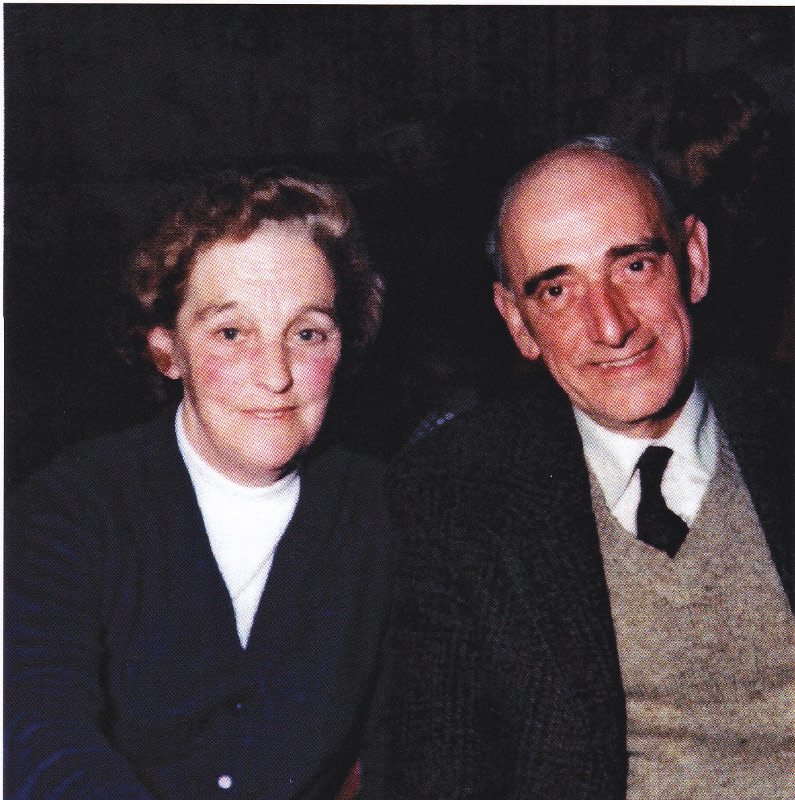
Well he liked to be in charge of things you know. But he was, he was very fair. I think he was a good dad, particularly when the kids were young he used to take them to play cricket. But the lads you know, when they were acting up, we used to say ‘watch out, your dad’s on the war path’, and they used to all go quiet. And they used to stuff things away. No, he was very good.
He was a kind person. He was very good to me. I don’t know if I can just pinpoint one particular thing, you know. He was very kind. We were married for 57 years.
Well it’s not all one long honeymoon. You’ve got to give and take you know. Perhaps you don’t always agree with one another but you come to some solution you know. As I say, anyone who says they never had a cross word in their lives or disagreed, I can’t believe it. And everybody has their own opinion on things, you just have to come to some joint agreement on things. But he did like to be in charge (laugh)
Yes we moved around an awful lot with his job you see. When we got married we lived with my parents for about a year, and then we got what they called a corporation house, where you rented a house from the corporation. It had nothing to do with the railroad, it was the town itself. It was in Anfield Road, and there were this row of houses and opposite was this golf course. It was not a bad house at all, it was quite nice. That was the first house together. The first baby I had I was still at home. So we were with them more than a year because the first baby was born just one year after we got married. Because we were married on the 9th of August and she was born on the 12th of August. Her name was Geraldine. Geraldine Mary. Why Geraldine, I don’t know. I quite liked it at the time. But she was only two days old when she died. And of course had she lived, she’d have been 65 years old now. It’s about three years after that Pete was born.
It was hard. Because when you come out from the hospital you bump into friends you know who had children and you know that made it hard. Something you never forget, but you get over it. In some ways now, you know, looking back, if that child had lived, she’d probably have been brain damaged in some way because she had cerebral haemorrhage. It was really sad. I remember they took me to see her, they didn’t give you the babies then. I only saw her once. You know you when you think that these days when babies are like that, you can hold them, but you never did back then. Things were different in those days. They only took me down to see her once. She only lived two days you see.
We were still living in my parents’ house, yes we came back there, and then we got a corporation house. Because Pete was born at Anfield Road, where we lived.
Well he was born prematurely- a month early. I was in the Doctor at three months because I thought I was having a miscarriage but I didn’t. He used to give me some medicine to take and I’d go to sleep all the time. Complete rest it was supposed to be. I was still working at the time. Then I was working at a place called Edwards Brothers, in the office. I didn’t go back to work then when I came out from the hospital. I was at home then, and he was born a month premature. He wasn’t too long in the hospital, because he was 5 pounds something. And then when we came out, I don’t know just exactly how old he was, only a matter of weeks, he was back in hospital again.
I took him to the clinic one day and he hadn’t gained as much as he should. They said they thought he’d got whooping cough without the whoop. As a youngster he used to suffer quite badly from catarrh. He outgrew it. But he was in hospital a few weeks, and then he came home and we though how wonderful he looked. But when I look at pictures of him then, he looked like a little skeleton. I know a friend of mine came over once, Ronnie was working then, and she said she could have cried, his two little legs looked just like pencils. But once he turned three months he was fine.
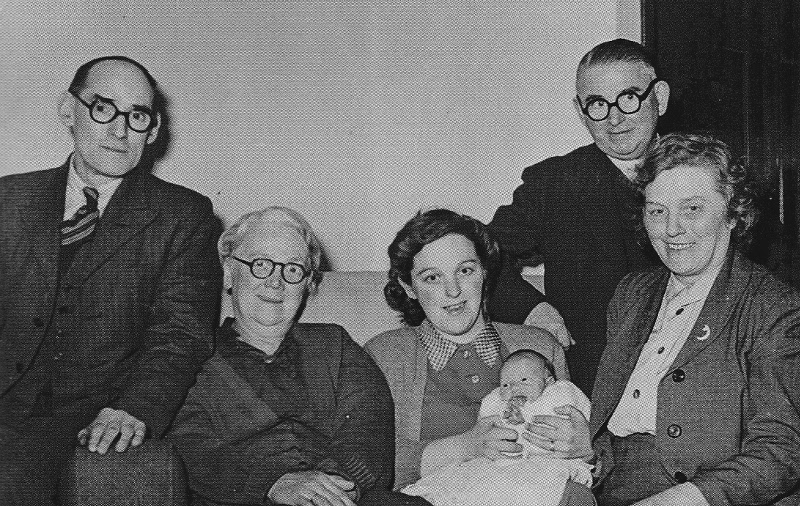
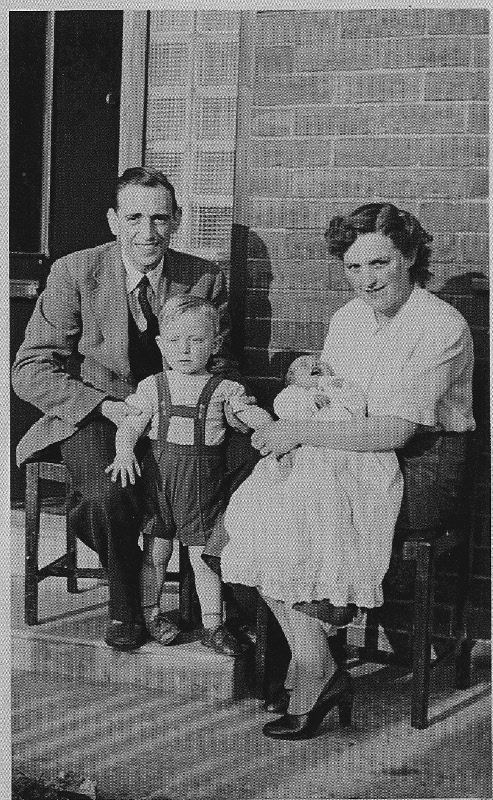
Yes we were still in Anfield Road. Pete was born in the hospital, the first babies you always had in the hospital. After that they had these maternity homes and John was born there. He was a very good lad because he was born exactly the day they gave me. Funnily enough Pete was born a month early on the 21st of March and he should have been born on the 18th of April and that was the day John was born. And just over two years between Pete and John and then John and Andy. And we were still living in Anfield Road when Andy was born. They were all born in Bolton.
It was just Anne that was born in Birmingham. And she was about five years younger. She’s nearly 10 years younger than Peter. We moved then from Bolton to a place in Birmingham. That was a railway house- the railway had houses. We were there for about two years, and then we moved back to Bolton because he was working then in Manchester. I couldn’t get back there quick enough, but it was never the same going back. We were there a couple of years, and then we went to Nantwich, we were there a while and then we went to Sutton Coldfield. This is the longest place we’ve ever been in, Hemel Hempstead.
Peter’s second name was Ronald- Peter Ronald Smith. I think we went through lots of names and decided on Peter. We called him John because Ronnie wanted him named after his dad- but I regret that now. I wish we said Michael John instead of John Michael, it would have made things easier. I never realized at the time but they used to laugh at school. I don’t know how we chose Andrews’ name really (laugh) His middle name is Jerome. Ben used to always make fun of that. It came from the idea of Jeremy, it was quite popular then. Oh, Anne, it was a family decision. She was called Anne Clair. I remember Andrew once, Anne was in her pram, and we were walking along and he came running along down the street and hopped on the wheel of the pram and peered in and said “Hello Annie Clara” (laugh)
When we came home with Anne, they were all sat on the settee there, and they each her their turn you know, looking at her. I can remember Pete saying “she just looks like a little kitten’. (laugh)
When Anne was a toddler, when anything wasn’t you know going right, it was always John she ran to.
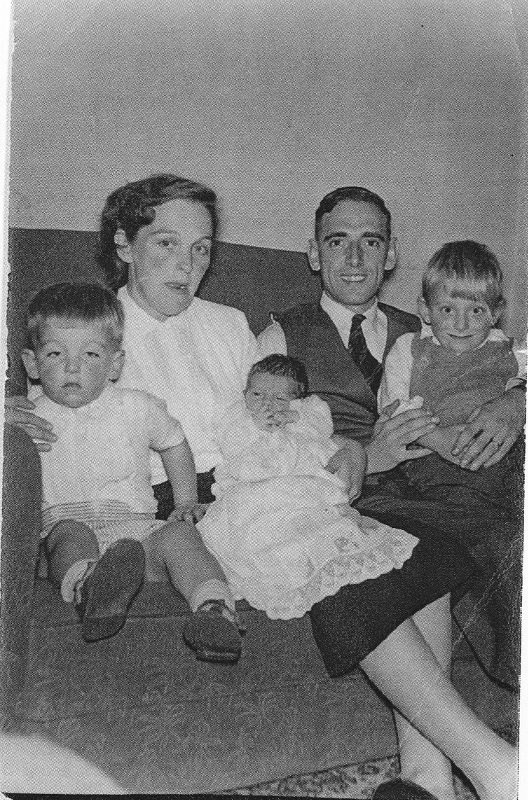
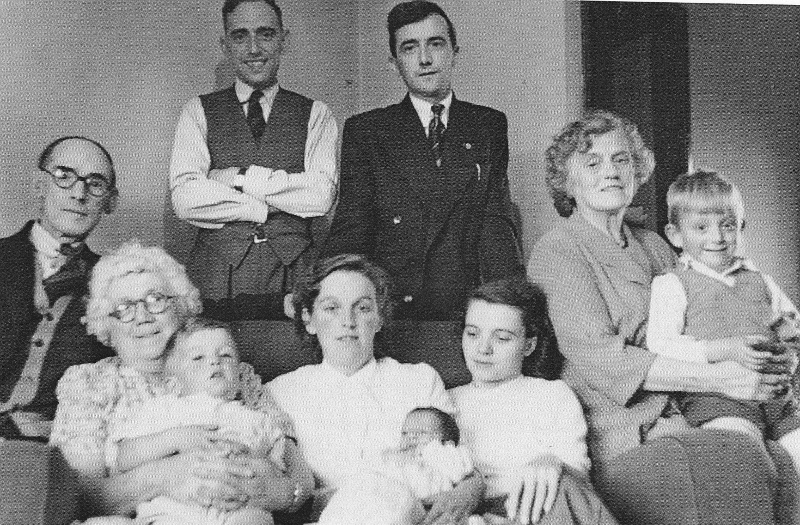
Well, Pete had rheumatic fever twice. He was seven the first time and a couple of years later again when we were in Sutton Coldfield. He was in the hospital a couple of weeks, he was in over Christmas when we were in Sutton Coldfield. Prior to that, we were down in Chelmsford with a friend of Ronnie’s he was in the Navy with, and his wife, and they had one boy, then they had twin boys- so they had three boys. Pete wasn’t well then. We had to take him to the Doctor’s there and we were so concerned because we thought he might have had polio or something like that. But then they diagnosed him with rheumatic fever and he was in hospital for six or seven weeks. His dad used to go down to Chelmsford once a week and I used to go down on weekends. We used to stay with Doug and Rose. And then he had it again when we were in Sutton Coldfield.
They took him into Birmingham Children’s Hospital. That was when he was in all over Christmas because I remember when we took him his present’s there- Ronnie went Christmas Eve and I went Christmas day. And John saying “I wish I was in hospital” (laugh) because they got all these toys.
He had to keep going back for check- ups to see if it affected his heart. And one Doctor said to us ‘if my heart was as good as this, I’d be happy.’ He’s been all right since then.
He was always shy. I could always understand John because daft as it may seem, I was always very shy as well. He was a bit on the shy side, you know. He was a good lad.
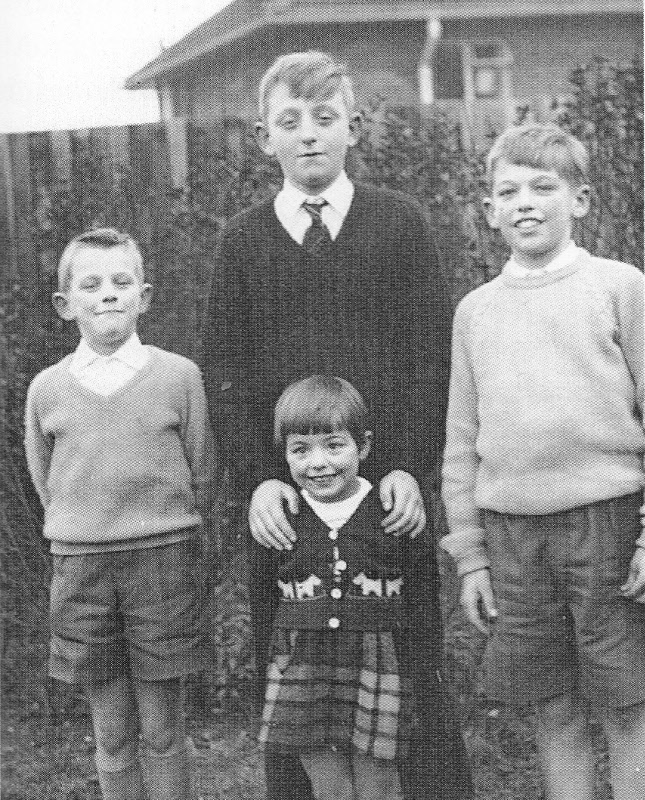
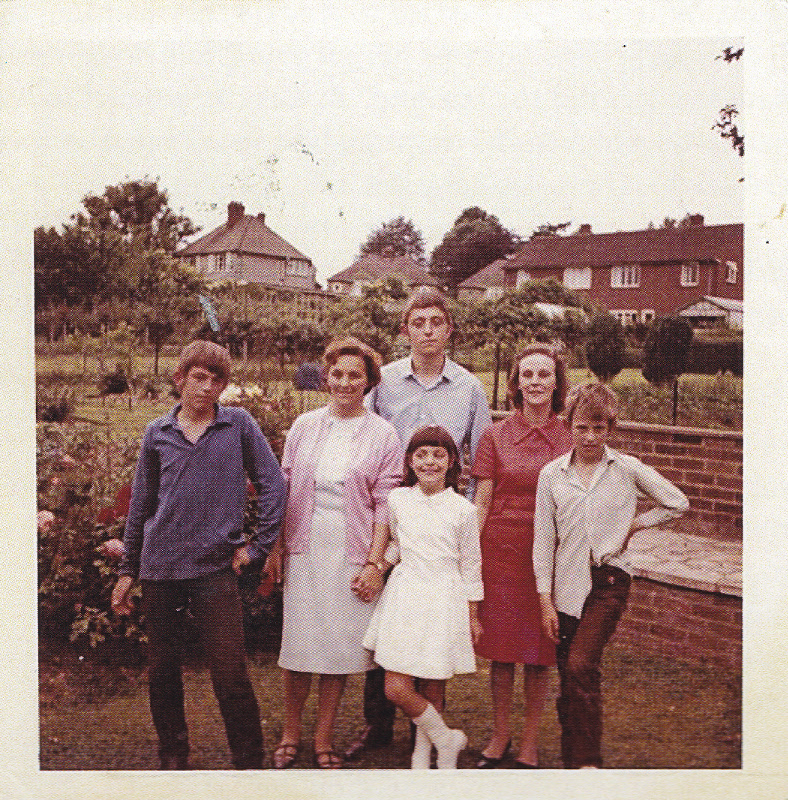
Oh, he was like a caged animal. He didn’t like being kept indoors- he always wanted to be outdoors. I remember one time, all the kids in the close were all inside watching the snow fall. Andy got a big spade and went outside and dug this big path all the way around the close (laughs). He loved being outside. Mind you, they all liked playing their sport. John played cricket and football. Andy played a lot of sport. He played golf as well. He still plays football. Mind you, it is the old man’s team now, but they still do it.
Yes, they used to tease her sometimes you know. That was when she was getting a bit older. She used to say “Andy’s done it again” and I knew what was coming. Her bedroom was in that side room and the light came down like that. And she had this teddy bear and lots of bits of fluffy toys and he’d hanged this one, the teddy bear by its neck. And he’d sat the other ones in a circle and he’d called it the hanging.
The first time Anne was going to Canada, she was going on her own, I went down to the airport to see her off. And she told her after, the man said I’m not letting you through until you give me a smile. And she told me when she got home she was frightened of being sick on the plane, she had this fear of being sick on the plane. So I said to Andy when she was getting off, just behave and don’t mention anything about being sick. And he said ‘no of course I won’t”. And then then the day she left, she was going up the walk and the bedroom window opens and he shouts “Anne” and made a vomiting noise.
And she had this guinea pig, Pepper it was called. And it died and she was really upset about this. The day afterwards in the kitchen, Andy was in there looking in the cupboard and I said ‘what are you looking for’ and he said “I can’t find the pepper anywhere”. (laughs) No, he’s changed completely he’s changed a lot since then. He was a good lad, but he was a very active sort of lad, he liked to be doing things all the time.
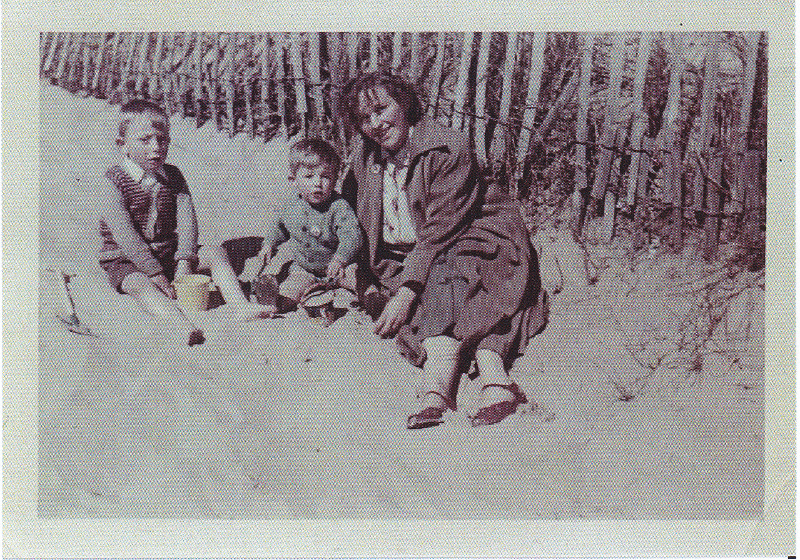
We always went on holidays in the summer. We used to go to holiday camp sometimes and there were plenty of activities going on there- swimming, games and all sorts of stuff.
One time we went to Holland after Anne was born. We rented this house, self-catered, and it was really nice, and the people next door were also really nice. They came over one night and said “there’s a film on tonight, it’s English with Dutch sub-titles” and they went in and she made this nice little supper.
One day Ronnie and the three lads hired bicycles and they went off cycling and I took Anne to this little beach and we stayed on this beach all afternoon. She played with this little Dutch boy, she was speaking English and he was speaking Dutch and they got on like a house on fire. And then we went to Spain with them all. We used to travel by overnight train. We got a reduction on travel, a discount by train. That was really one reason why we never had a car. Ronnie had a free pass everywhere, and we could get passes at a discount. With four of them it was really a lot cheaper. Because a car was really a luxury then.
We always used to play card games and we used to play Monopoly. That was always a favourite they used to play. We used to play quite a lot of cards. The lads all had stamp collections. I don’t know quite what happened to them all. I know Andy still has some. They used to get these first day covers. They all collected stamps. One of them had a coin collection as well.
We used to go away for the day quite a lot and we went on holiday as well. I think Anne was at home when he retired. I think the others were gone then. Yes, I think the others had probably moved out then. I always remember the first time John went to Canada, I thought I’d probably never see him again. Because Canada seemed such a long way away, now it seems so ridiculous. And Pete moved away when he got married and moved away. We were living here in this house. It was in Welwyn Garden City. Anne was a bridesmaid. When he got married to Angela they had Lancashire Hotpot. I don’t think John went to that wedding. It sounded ridiculous this hotpot thing, but it was really nice. At Anne’s wedding they had this hall, and Graham’s sisters did the cooking. It was like a buffet, it was all very nice. Mark was a youngster then, and they had to take him to the hospital, he’d stuck a fork at the back of his throat. Ben wore a Shaking Stevens suit. I can see him now twisting around.
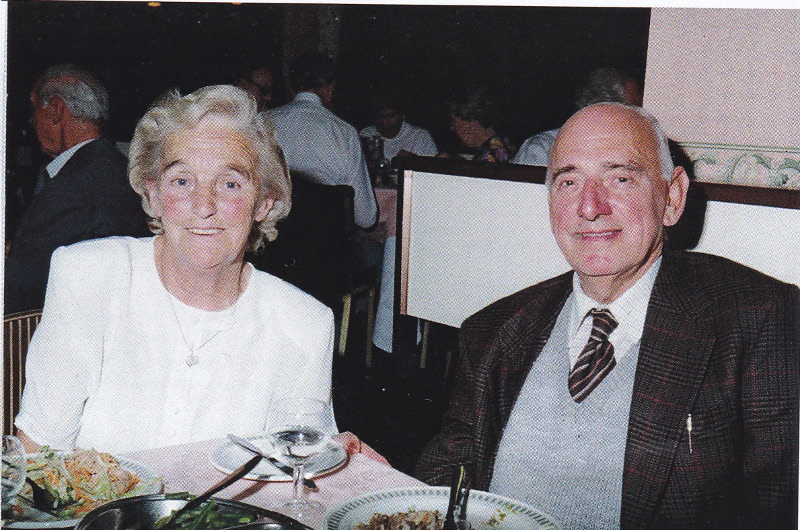
The one that really sticks in my mind is Marrakech. There was only Ronnie and I there together. We were there for a week. I think it was just the complete different culture and it always sticks in my mind. It was so much different. When we went to the Souks, we had this little guide, an older man, not very tall. He had this thing like a Fez on his head. And he had quite a sense of humour. He said ‘now just before we go anywhere, should by any remote chance if anybody gets lost, don’t worry, just stand exactly where you are, and we’ll probably find you in the next day or two” (laugh) And another thing he said “don’t make eye contact with the children” and I thought my God I’ve already smiled at one or two, and he said “you’ll never get rid of them” and I remember this one little boy, he was a bit cross-eyed and he had such a smile. It was just so different there- we went out to different places. We had some mint tea, which I didn`t like at first. Where ever you went, there was somebody begging. I remember one lunch time, we sat outside and had chicken, and just on this wall, a lady was sat with a baby and a little girl, and whenever somebody left, she would come down and scoop up the food that was left and give it to the baby. I thought how awful. I only ate about half of my chicken, and she came across and took my food. So we gave her something and she was so happy. And her child came around and put her arms around my neck and she was the most beautiful child I`d ever seen.
It was completely different.
Here. When I look back, Sutton Coldfield was very nice. It was a pleasant place to live in, people were quite nice. But I prefer here- we lived here the longest. It was hard moving around. The kids adapted quite well, but it wasn’t that easy for them. When we were looking for this place, we were undecided about this place or another one round the corner near the town. And we weren’t 100% sure. And then we went back home and one night the phone rang, and it was Ronnie, and he said I’ve bought a house. And we went down there one weekend and I walked in and thought “I love it” and I’ve really enjoyed living here.
Steven. I was thrilled to bits when I found out I was going to be a grandmother, absolutely delighted. I can remember going to see him. When we got there he was asleep in his pram. And Pete picked him up and put him on his shoulder. He was a delightful little boy, he really was. He was always a clever lad.
Ten, I think. Steven, Ben, Nicola, Mark, Hannah, Ulf, Niels, Signe, Anna and David. And one great grandchild and another one on the way.
Ben was funny. He was a nut and a half. I find him very loveable and easy to get along with. Stephen was a bonny baby too. I remember Andy and Kirsten came over with the children. We had a little red tricycle in the garage. And Niels was playing about on this, and he got on the tricycle and was riding it down the drive and he was on the road with it, and the next thing we knew, there was a man coming up the drive with him, he had picked him up in the road on the tricycle. I suppose there were lots of funny things that went on. Nicola was a bonny baby too. She has a good head on her shoulders. She looks a lot like Sheila. I love them all, really.
Well the children. I’m glad that the children are all different, in each of them there’s something. And I’m glad they are all happy and doing what they want to do. There comes a time, although it’s long past now, that you have to let go. They live their own lives now, don’t they? I always look forward to seeing them and talking to them on the phone. So long as they come to visit their mum (laughs)
Well I hope that anybody I’ve offended has forgiven me (laughs). I don’t know really. I hope that people think of me as a reasonable person, not too bossy or interfering.
I did, I loved it! And I’ve really enjoyed you coming.